
 Grades 1 to 4
Classroom lesson plan
Color Mixing
with Marsha Valk
Objectives
Students will be able to
- master color mixing
- demonstrate different color theory techniques
Essential questions
Ask the room
- How are colors mixed?
- What colors can be created by mixing certain combinations?
- How do you mix on a Gelli Arts® plate?
- What are primary colors?
- What are secondary colors?

Materials4 items
Watch the lesson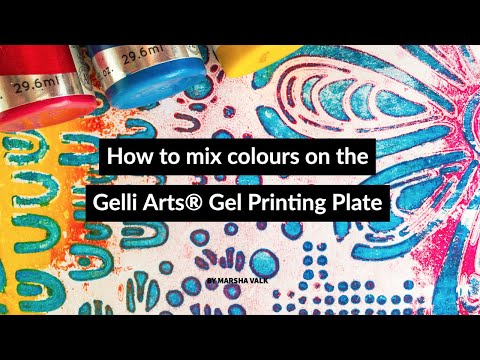
Notes for the teacher
• Using quality paints helps with the success of color mixing. Secondly, intuitively or consciously, we use the basic principles of color theory. • Color theory doesn’t have to be hard. Even basic knowledge of the primary and secondary colors goes a long way. • However, a color wheel can be a handy tool to have because it not only tells you exactly what color you’re going to get when you mix two colors together, but also which color combinations work best.
Vocabulary
- Primary Colors Blue, Red, Yellow
- Secondary Colors Green, Purple, Orange
- Monochromatic Containing or using only one color
- Analogous Groups of three colors that are next to each other on the color wheel
- Complementary Pairs of colors which, when combined or mixed, cancel each other out. These colors also sit on opposing ends of the color wheel
- Triadic Color scheme is comprised of three colors evenly spaced on the color wheel
From Marsha Valk’s prints


Lesson plan by Marsha Valk for Gelli Arts®. Photos from Marsha Valk’s color mixing post on the Gelli Arts® blog.
Grades 1 to 4
All 11 More lessons for this band
The course
Your Printmaking Journey · Fall Edition





13classes, six weeks
October 18 to November 28, 2026
13 artists teaching on video, lifetime access. $199, enroll anytime.